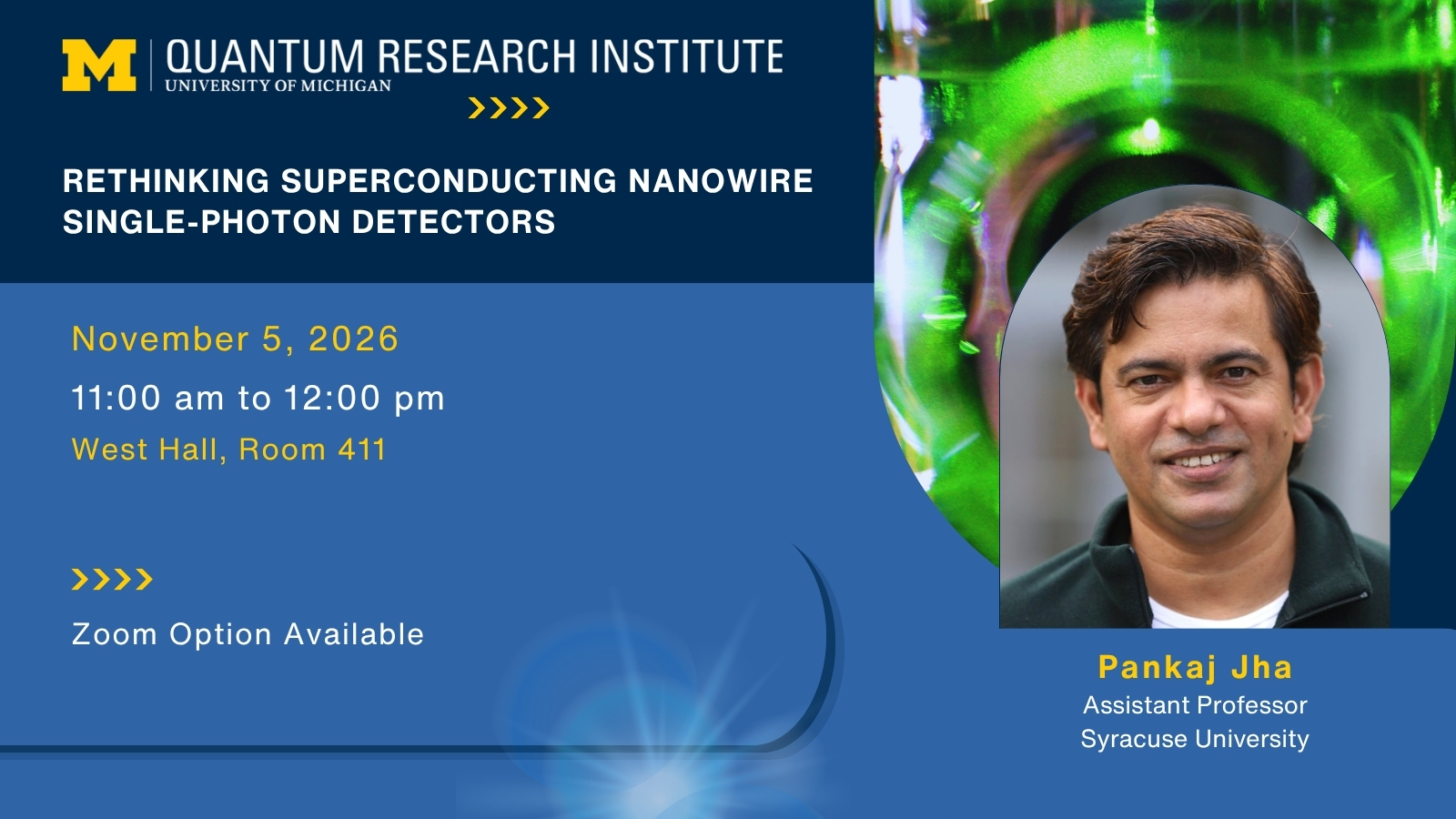
Zoom: In the Meeting Invite
In-Person: West Hall, Room 411
Abstract:
Superconducting nanowire single-photon detectors combine near-perfect efficiency, exceptional timing precision, and almost no false counts, making them a key enabling technology for quantum information science. Yet two long-standing constraints limit their wider use: they must operate at liquid-helium temperatures, and their design imposes a fundamental trade-off. A large active area captures more light, while a small one offers higher speed, lower noise, and sharper timing. In this talk, I will present two complementary approaches to easing these constraints. The first rethinks the material. Exfoliated van der Waals flakes of an iron-based superconductor produce a fast, self-resetting photoresponse well above liquid-helium temperatures. I will discuss what it will take to achieve single-photon sensitivity. Because this approach leads to smaller detectors, efficient light collection becomes even more important. The second approach rethinks optics. Cryogenic dielectric metasurfaces act as flat lenses, allowing a small detector to collect light like a much larger one. They can also add new functions, such as sorting photons by polarization onto neighboring detectors. Together, these approaches point toward single-photon detectors that are warmer, smaller, and more capable, with reduced size, weight, power, cost, and cooling demands. They could open new opportunities across quantum technologies, photonics, and sensing.
Bio:
Pankaj K. Jha is an Assistant Professor of Electrical Engineering and Computer Science at Syracuse University, with an affiliated appointment in Physics, where he leads the Quantum Technology Laboratory. He received his PhD in Physics from Texas A&M University and was a postdoctoral scholar at UC Berkeley and Caltech before joining Syracuse. His research integrates 2D materials, metamaterials, and superconducting devices to advance quantum photonic technologies, focusing on next-generation single-photon detectors. His work has been highlighted by Lawrence Berkeley National Laboratory, the Kavli Foundation, and the Moore Foundation. His honors include a 2023 Air Force Research Laboratory (AFRL) Visiting Faculty Research Program Fellowship and a 2023 Syracuse University Faculty Creative Activities and Research (FCAR) Grant. His research is supported by the NSF, AFRL, DARPA, and Google.