
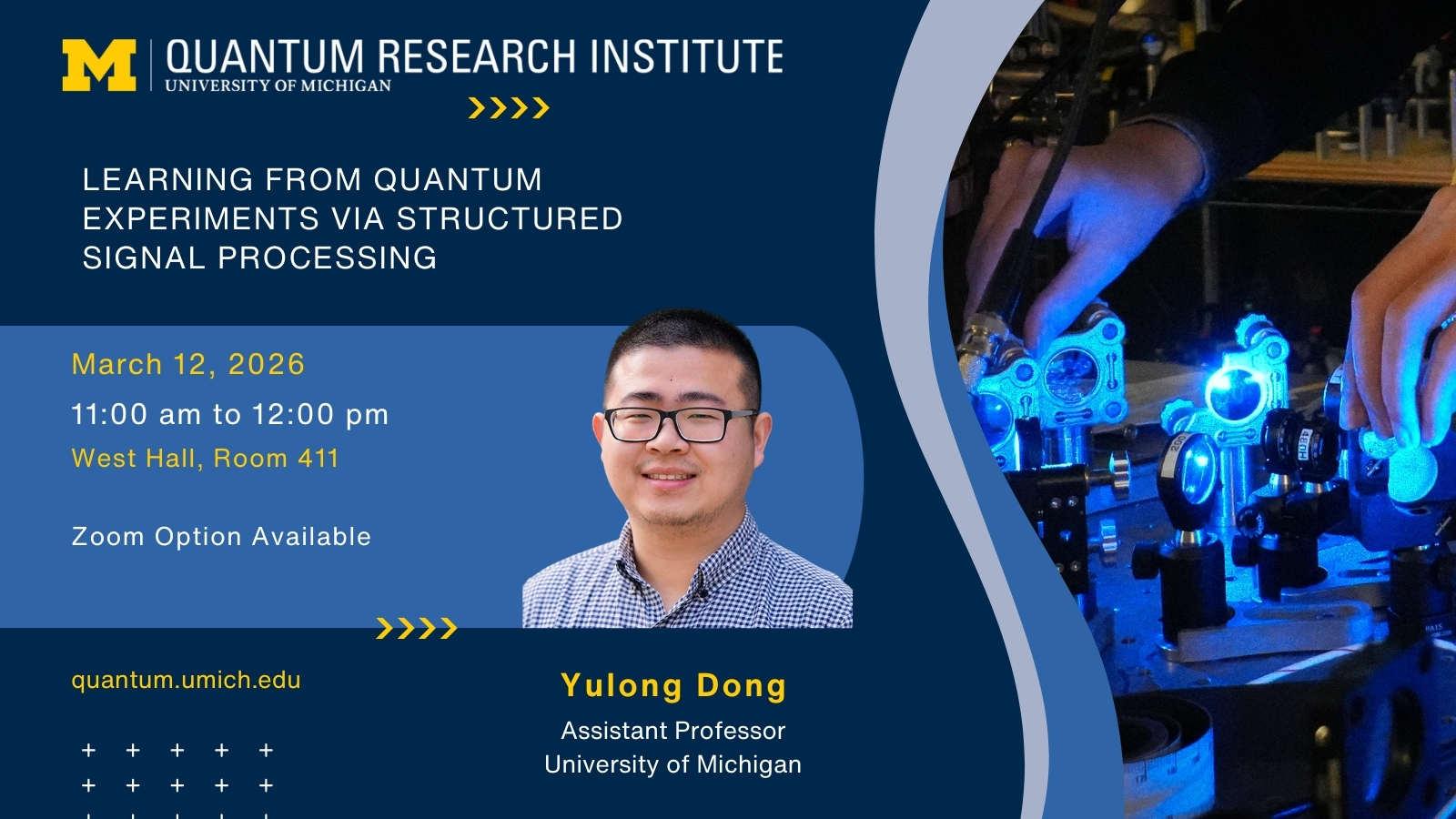
Quantum Research Institute | Learning from Quantum Experiments via Structured Signal Processing: Yulong Dong, University of Michigan
In-Person: West Hall 411Zoom: https://umich.zoom.us/j/98748463202?jst=2 Abstract:The pursuit of quantum advantage in solving large-scale computational problems is often seen as a shining treasure. Achieving this goal, however, requires the accurate realization of smaller-scale quantum gates and control operations. Understanding and characterizing modular gate and control errors is therefore essential for building reliable quantum applications. Earlier work ...
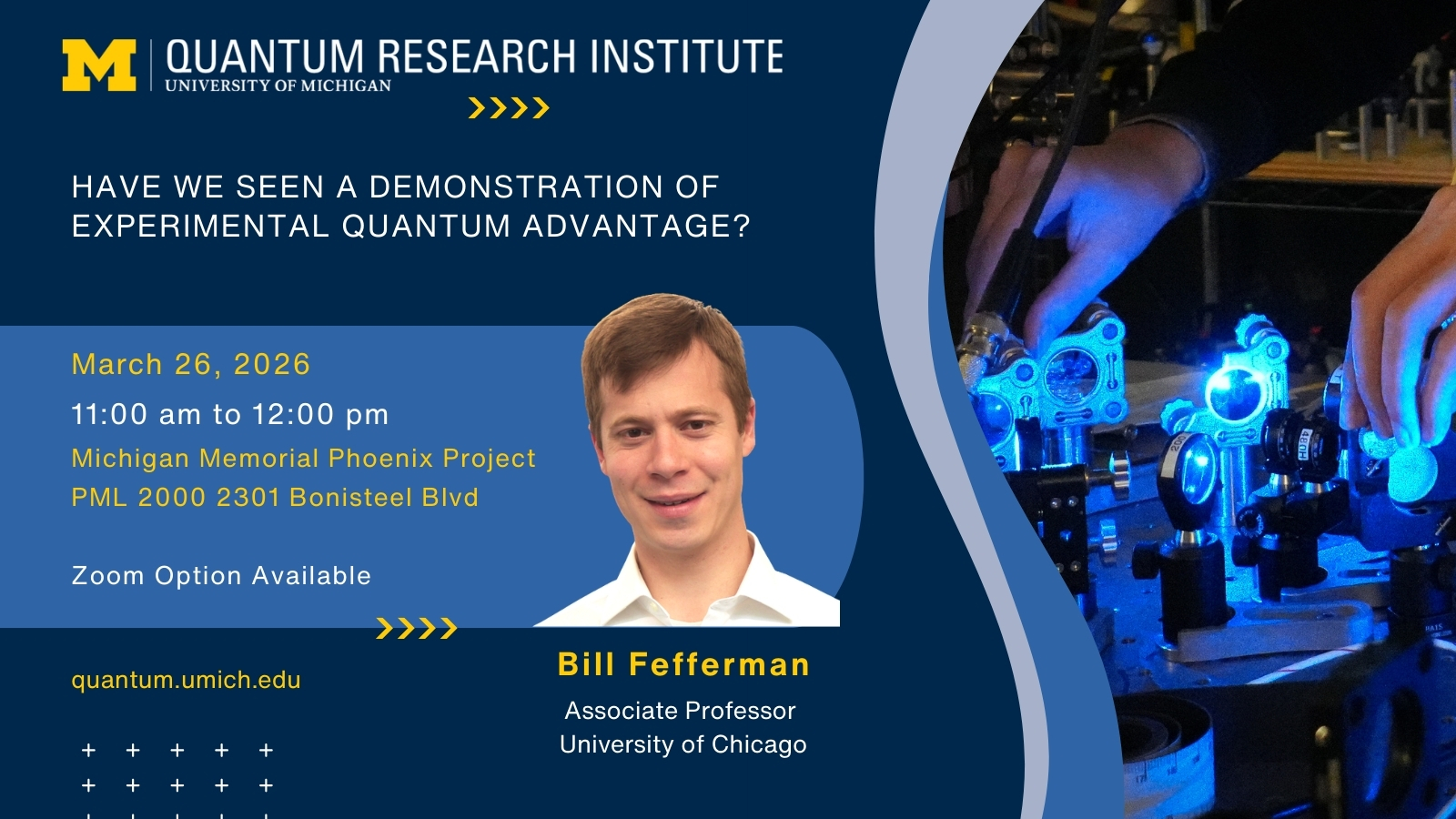
Quantum Research Institute | Have we seen a demonstration of experimental quantum advantage?: Bill Fefferman (University of Chicago)
In-Person: Michigan Memorial Phoenix Project, 2301 Bonisteel Blvd, Ann Arbor, MI 48109, USA, PML2000Zoom: https://umich.zoom.us/j/94764879233?jst=2 Abstract: A major goal for the field of quantum computation is “quantum advantage” — the first experimental demonstration of a quantum computation that is beyond the capabilities of any classical computer. While we have now seen many quantum advantage claims ...
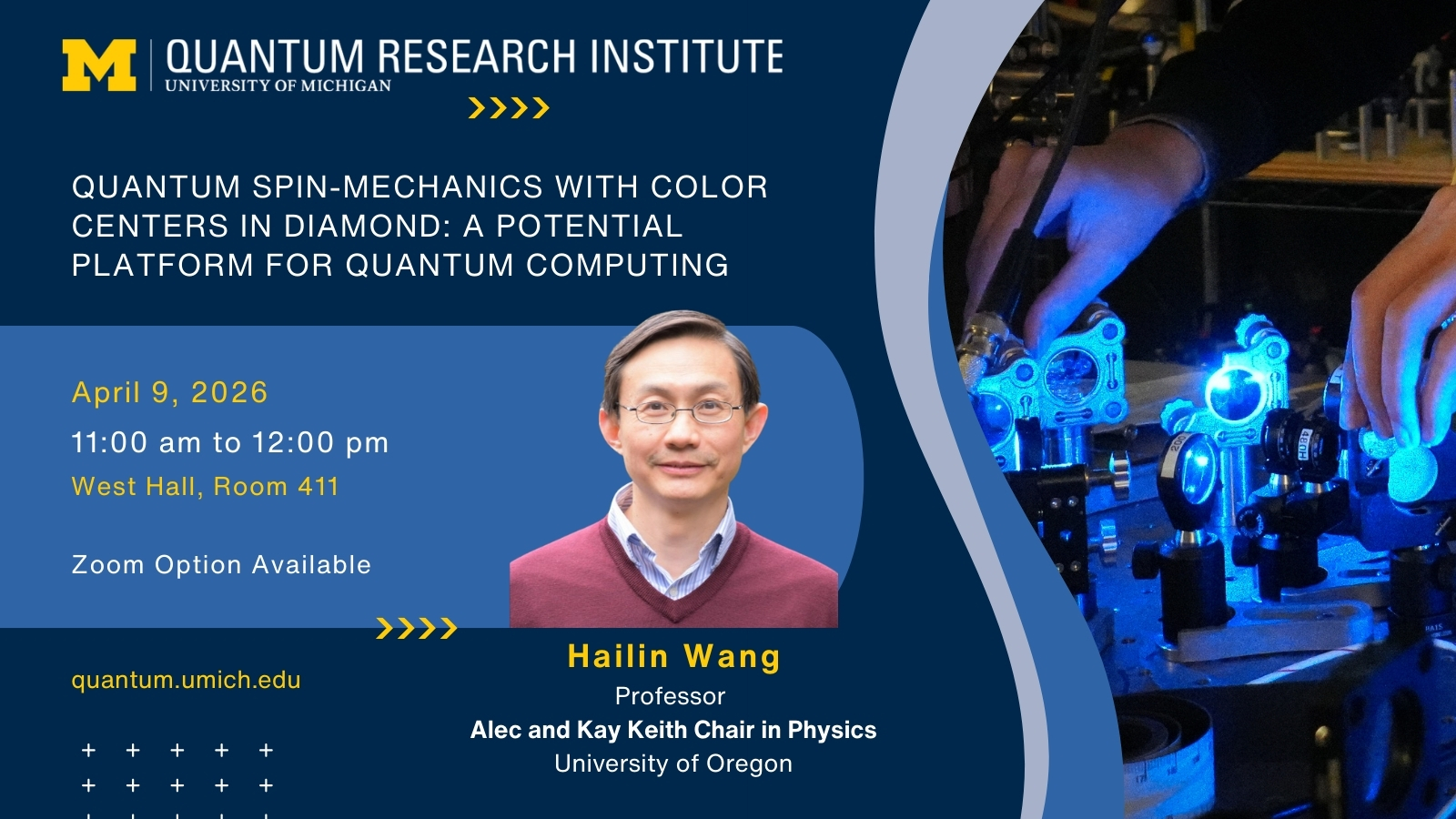
Quantum Research Institute | Quantum Spin-Mechanics with Color Centers in Diamond: A Potential Platform for Quantum Computing: Hailin Wang (University of Oregon)
In-Person: West Hall 411Zoom: https://umich.zoom.us/j/91761768567?jst=2 Abstract:In a spin-mechanical system, electron spins are coupled to vibrations of a nanomechanical resonator. Coherent interactions between single spins and single phonons take place in the quantum regime of spin-mechanics. A network of these resonators can enable phonon-mediated coupling between distant electron spin, leading to a mechanical quantum network of ...
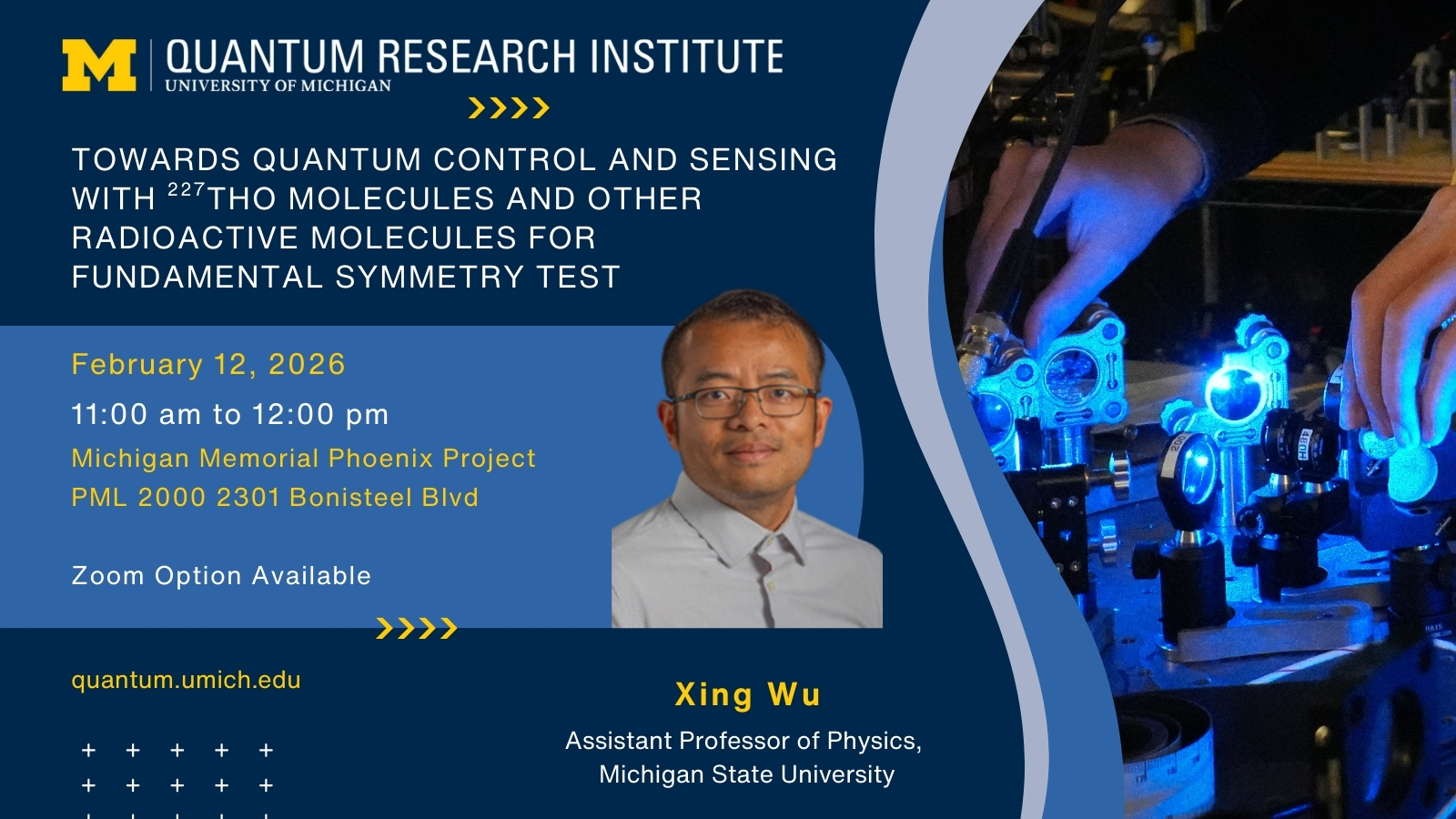
Quantum Research Institute | Towards Quantum Control and Sensing with 227ThO Molecules and Other Radioactive Molecules for Fundamental Symmetry Test: Xing Wu (Michigan State University)
In-Person: West Hall 411Zoom: https://umich.zoom.us/j/99497477868?jst=2 Abstract:The Standard Model of particle physics accurately describes all fundamental particles discovered so far. However, it is unable to address two great mysteries in physics, the nature of dark matter and why matter dominates over antimatter throughout the Universe. Novel theories beyond the Standard Model may explain these phenomena. These ...
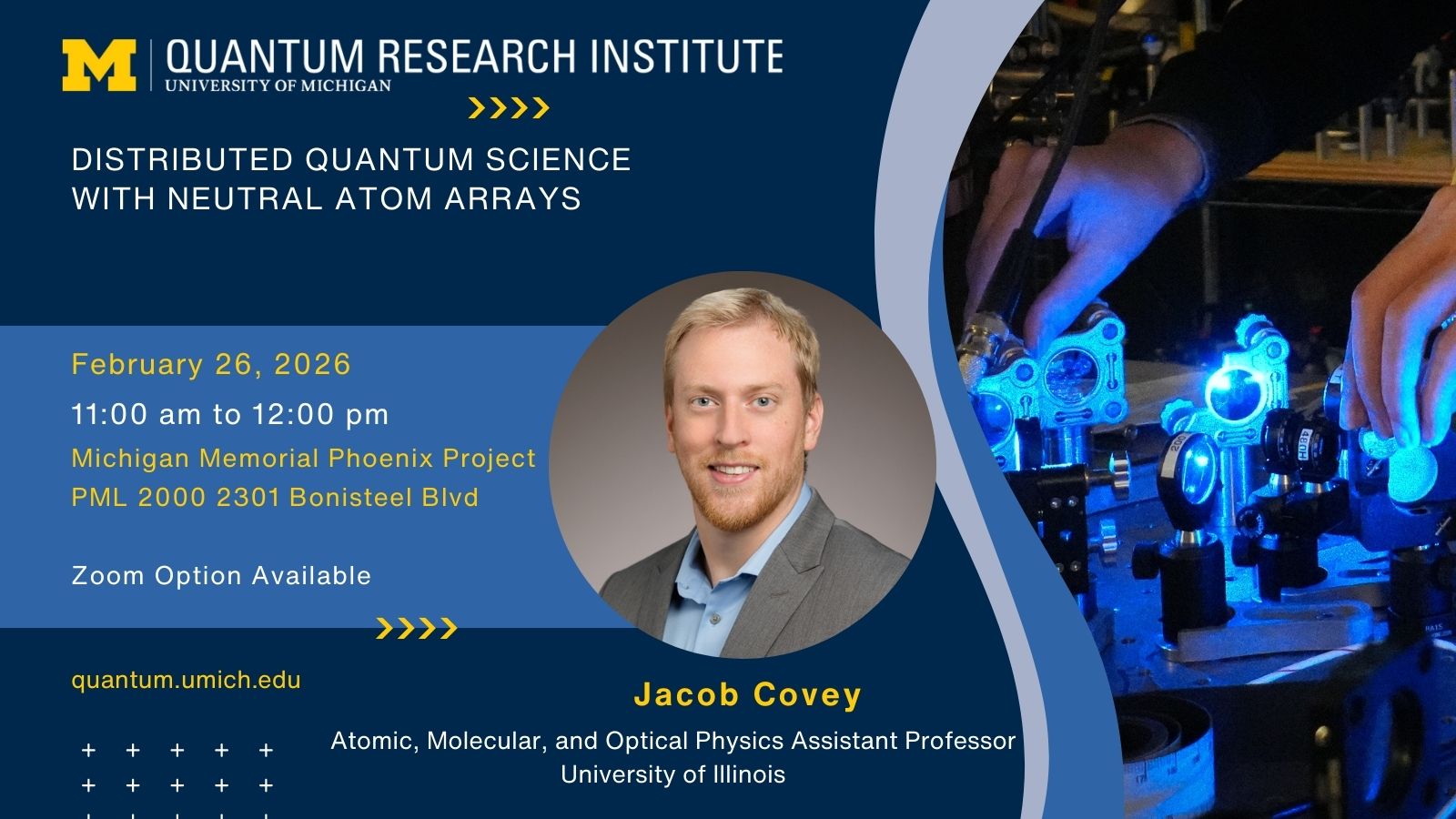
Quantum Research Institute | Distributed quantum science with neutral atom arrays: Jacob Covey (University of Illinois)
In-Person: Michigan Memorial Phoenix Project, 2301 Bonisteel Blvd, Ann Arbor, MI 48109, USA, PML2000
Zoom: https://umich.zoom.us/j/99940829961?jst=2
Abstract: The realization of fast and high-fidelity entanglement between separated arrays of neutral atoms would enable a host of new opportunities in quantum communication, distributed quantum sensing, and modular quantum computation. In this talk, I will describe two approaches we are ...
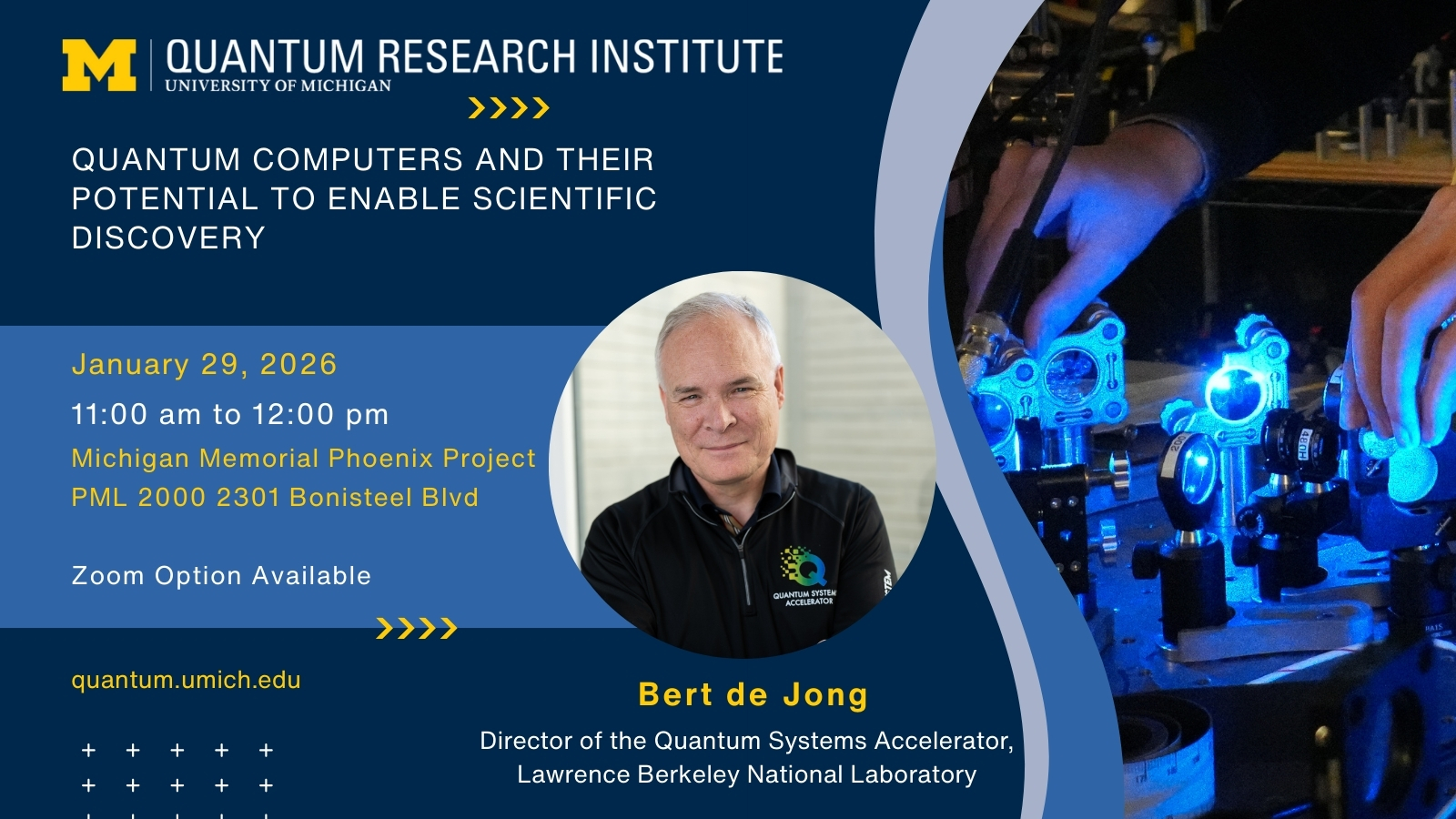
Quantum Research Institute | Quantum computers and their potential to enable scientific discovery: Bert de Jong (Lawrence Berkeley National Laboratory)
In-person: Michigan Memorial Phoenix Project, 2301 Bonisteel Blvd, Ann Arbor, MI 48109, USA, PML2000
Zoom: https://umich.zoom.us/j/98530700330?jst=2
Abstract:
Quantum technologies are advancing rapidly with a pathway to scientific discovery and quantum utility by 2030 for the Department of Energy community. Harnessing quantum technologies as they scale up will require next-generation software and integration with HPC and AI. Software frameworks ...
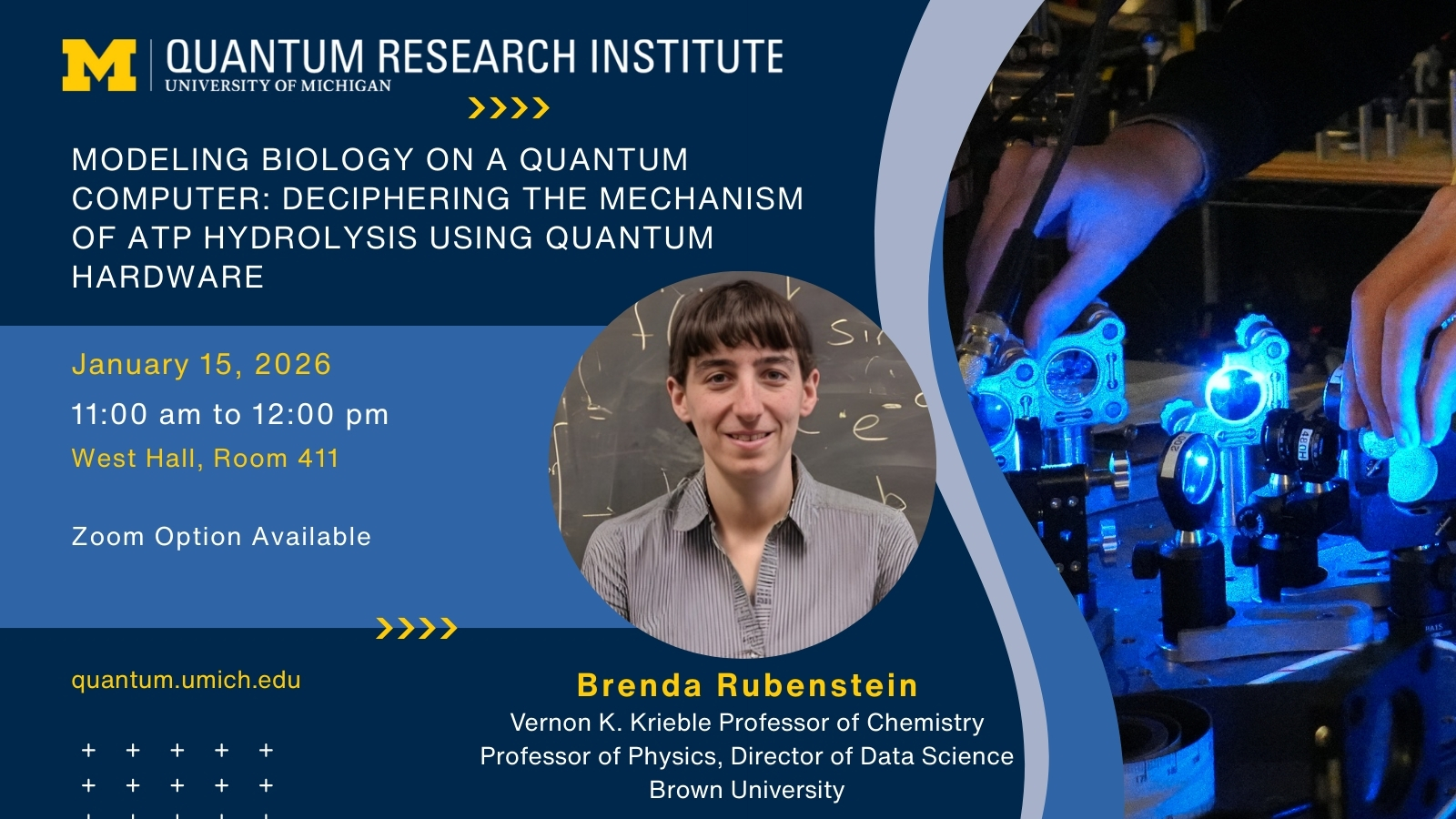
Cancelled: Quantum Research Institute | Modeling Biology on a Quantum Computer: Deciphering the Mechanism of ATP Hydrolysis Using Quantum Hardware: Brenda Rubenstein (Brown University)
This event has been cancelled. We apologize for the inconvenience. Abstract: The ability to model biochemical reaction dynamics on quantum hardware would open the door to the virtually exact description of enzymatic catalysis, accelerating the discovery of novel therapeutics. However, noisy hardware, the costs of computing gradients, and the number of qubits and gates required ...
Quantum Research Institute | New insights into system–bath interaction models for quantum ground- and thermal-state preparation: Zhiyan Ding – Assistant Professor, University of Michigan
In-person: Michigan Memorial Phoenix Project, 2301 Bonisteel Blvd, Ann Arbor, MI 48109, USA. Room PML2000
Zoom: https://umich.zoom.us/j/92778807694?jst=2
Abstract:
Quantum thermal-state and ground-state preparation are one of the fundamental algorithmic primitives with broad applications in quantum many-body physics, quantum chemistry, and materials science. In this talk, I will introduce dissipative quantum algorithms for preparing the ...